
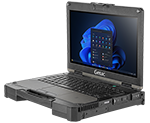
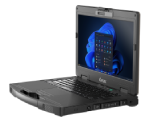
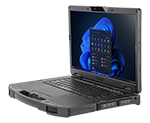
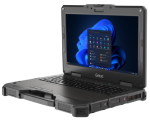













Rugged Devices for Fleet, Delivery, and Logistics Operations
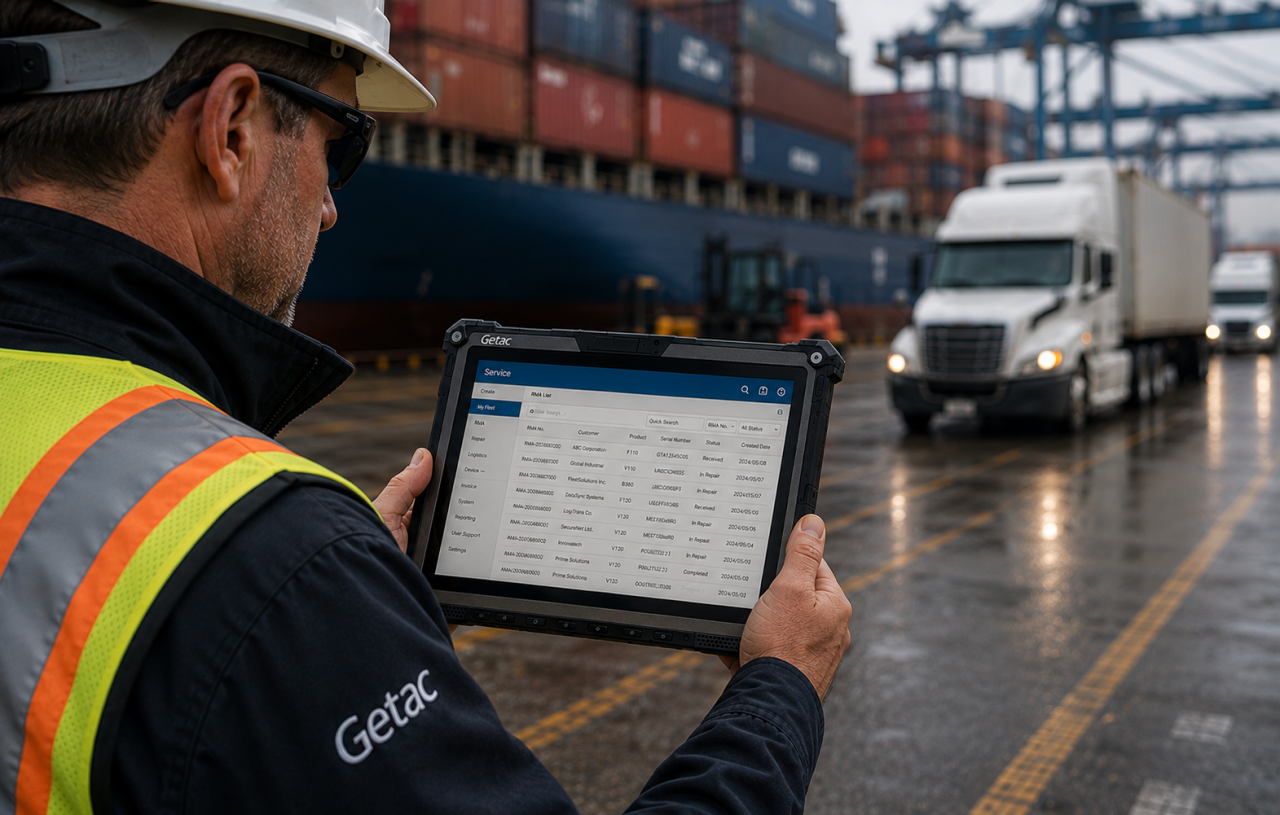
A tablet that overheats on the dash, cracks on the loading dock, or takes fifteen minutes to boot does not just cost you a device. It costs you a route, a delivery window, and a vehicle out of service. Getac rugged tablets and laptops are built to keep working where that happens. From last-mile delivery vans and long-haul cabs to cross-dock terminals, rail yards, and port operations, Getac keeps route planning, ELD and telematics, proof of delivery, and dispatch software running reliably across the entire fleet. Built for drivers, dispatchers, terminal supervisors, fleet IT teams, and logistics managers.
How Do Rugged Devices Keep Fleet and Logistics Operations Running?
Fleet IT directors and logistics operations managers run hundreds to thousands of devices across depots, terminals, vehicle types, and shifts. They do not lose those devices all at once. They lose them one at a time, all year, and every loss is a replacement, a re-provisioning, and a driver waiting. Getac rugged tablets are built to MIL-STD-810H with IP-rated sealing, so drivers and logistics teams finish their routes and shifts on the same hardware they started with.
A rugged tablet for transportation and logistics is a device engineered from the chassis up to MIL-STD-810H and IP standards to survive the cab, the dock, the yard, and the cold chain. According to IDC: Rugged has become the standard for fleets that cannot afford downtime: 65% of transportation and logistics organizations already put at least 10% of their IT budget into rugged devices, and 51% plan to increase that spend.
Should Fleet Operations Use Windows or Android Rugged Devices?
Getac offers both Windows and Android rugged devices, so transportation and logistics operations can standardize on the platform their teams already run. Android operators handling navigation, proof-of-delivery, route scanning, and telematics can deploy compact fully rugged Android tablets built for all-day in-cab mounting and handheld use at the door. Windows teams running Windows-based dispatch, TMS, and back-office applications can deploy fully rugged Windows tablets with AI-ready performance in-cab and at the terminal. All are built for the cab, dock, yard, and cold-chain conditions that destroy consumer-grade devices.
The platform decision usually comes down to what the back office already runs. Fleet teams work across cabs, loading docks, rail yards, ports, and cold-chain trailers where drops, vibration, temperature swings, and constant movement are part of the job. Getac builds both its Android and its Windows devices to the same MIL-STD-810H standard and backs both with the same 3-year Bumper-to-Bumper warranty, so the operating system stays a software decision rather than a durability tradeoff.

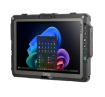
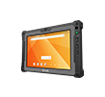
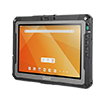
The ZX80 8” fully rugged Android rated IP67 for submersion, so last-mile and cold-chain drivers run proof of delivery, navigation, and scanning one-handed through a hundred stops a day. MIL-STD-810H certified for the drops, vibration, and temperature swings that come with the route.

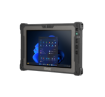
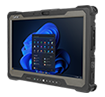
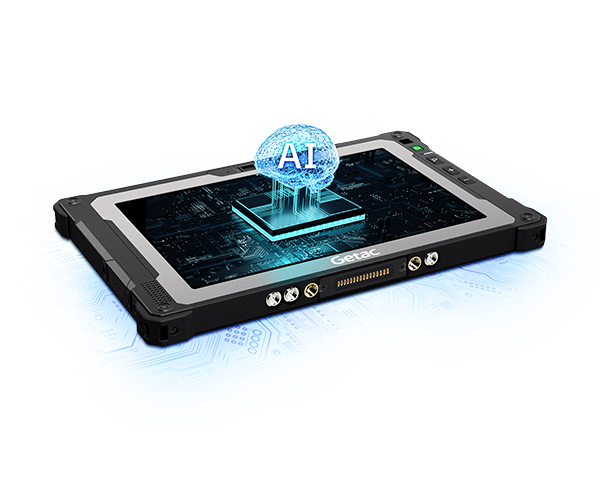
The ZX80W 8" fully rugged Windows tablet delivers AI-ready performance in a compact design, powered by Windows 11 IoT Enterprise LTSC, with extreme durability and a class-leading battery capacity for extended, reliable performance.
What Challenges Do Transportation Operations Face with Consumer-Grade Devices?
- Managing fleet-scale device deployments across depots, terminals, and vehicle types, from 100 to 10,000+ devices, without a centralized management platform or MDM compatibility.
- Maintaining reliable connectivity across highways, rural dead zones, port terminals, and steel-structure warehouses where consumer hardware drops out mid-route.
- Cutting OS licensing, patching, and update overhead across thousands of in-cab devices that require individual reconfiguration every time a unit is swapped.
- Protecting dispatch, telematics, and delivery systems with device-level security and managed updates that consumer hardware was never designed to support at fleet scale.
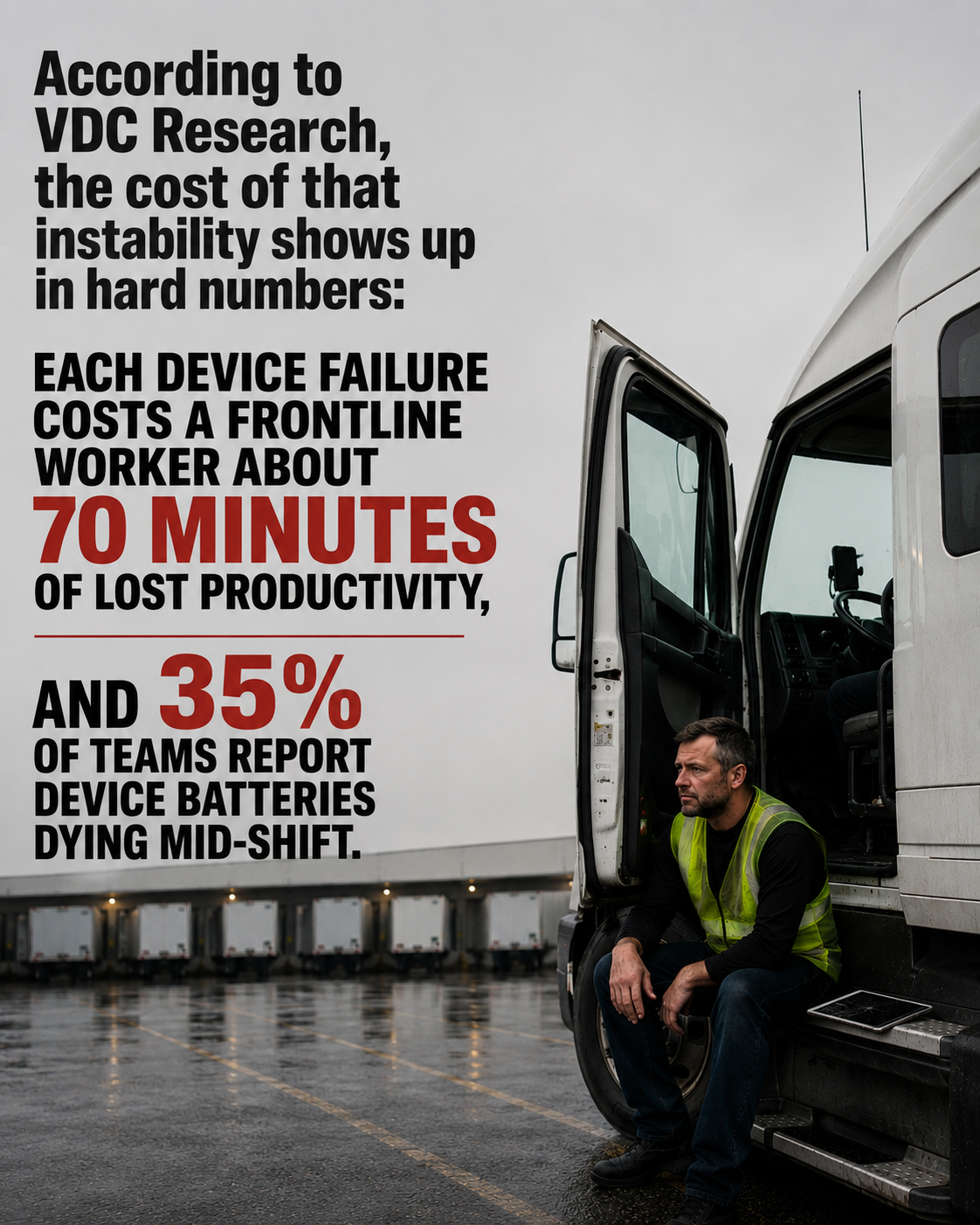
According to VDC Research, the cost of that instability shows up in hard numbers: each device failure costs a frontline worker about 70 minutes of lost productivity, and 35% of teams report device batteries dying mid-shift.
Together, these challenges create a reactive IT model with constant device replacements, driver downtime, and avoidable re-provisioning costs. Getac rugged hardware and fleet management tools are built to eliminate each of these failure points.
What Are the Most Common Use Cases for Getac Rugged Tablets in Transportation & Logistics?
How Do Rugged Tablets Support In-Cab and Vehicle-Mounted Computing?
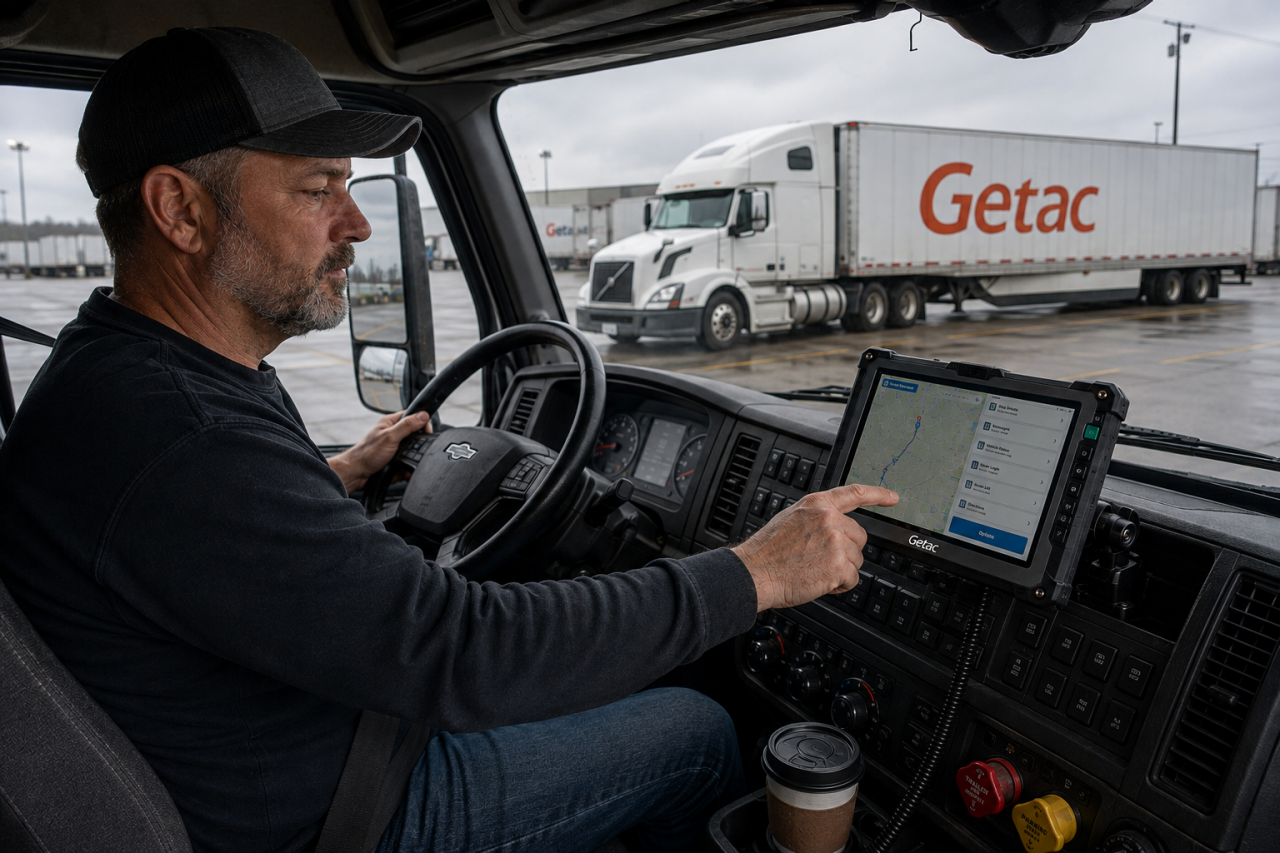
Vehicle-mounted rugged tablets put navigation, ELD/HOS logging, dispatch, and telematics directly in the cab, helping drivers follow routes, capture status updates, and stay compliant without a second device. Best fit: vehicle-dock compatible with Havis and Gamber-Johnson mounting systems.
How Do Rugged Tablets Support Proof-of-Delivery and Last-Mile?
Tablets are the driver's primary tool at the door: capturing signatures, scanning packages, photographing delivery locations, and syncing delivery status in real time. Best fit: compact, handheld-friendly, sunlight-readable rugged Android tablets.
What Rugged Tablet Is Used for Terminal, Cross-Dock, and Yard Operations?
Logistics does not stop at the dock door. Tablets handle gate check-in and check-out, trailer and container scanning, cross-dock sortation, GPS yard navigation, and cold-chain trailers where condensation kills consumer devices. Best fit: IP66/IP67-rated, sunlight-readable LumiBond display, rated for outdoor and cold-chain environments.
How Do Rugged Tablets Support Asset Tracking and RFID Across the Network?
With integrated RFID or Bluetooth scanning, tablets support trailer, container, and returnable-asset tagging, chain-of-custody tracking, and equipment location across terminals and yards. Best fit: supports integrated barcode scanning and RFID peripherals via USB-C and Pogo pin accessories.
How Do Rugged Tablets Help with Safety and Compliance Logging on the Road?
Tablets keep driver vehicle inspection reports (DVIR), hours-of-service logs, hazmat documentation, and digital SOP access in the cab, cutting paperwork and keeping a traceable record. Best fit: rugged devices compliant with ELD and DOT digital record-keeping requirements.
What Getac Software Supports Transportation & Logistics Operations?

How Does Getac KeyWedge Turn a Rugged Tablet Into a Barcode Scanner?
Simple, Cost-Effective Barcode Scanning
Getac KeyWedge is a barcode reader utility that turns any Getac Windows tablet with a rear camera into a barcode scanner, with no added hardware, no upgrades, and no SDK integration required. For operations that cannot justify integrated barcode hardware, KeyWedge is the low-cost alternative, supporting single and multiple barcode scanning. One download has drivers and terminal teams ready to scan.

How Does Getac Driving Safety Reduce Driver Distraction?
Reduce Driver Distraction on the Move
Getac Driving Safety is a utility that reduces driver distraction by limiting visual and manual interaction with the device while a vehicle is moving, helping delivery and commercial-vehicle operators keep their attention on the road and the vehicle under control. Your people are your most valuable assets, and Driving Safety is a cost-effective, reliable way to safeguard your workforce on the road and in the yard.
Why Do Transportation & Logistics Operations Choose Getac Over Consumer Devices?
Fleet buyers usually compare three things: a consumer tablet in a case, a semi-rugged device, and a fully rugged platform. The first two are cheaper on the purchase order and more expensive over three years, because neither warranty covers the accidental damage that defines cab and dock work. Getac builds rugged from the chassis up, and the 3-year Bumper-to-Bumper warranty covers the drops, vibration, and liquid ingress that void a consumer warranty on day one.

Industry-leading warranties

Advanced services to minimize downtime

Rugged and reliable devices

Docking compatibility, and accessories

Comprehensive Windows and Android portfolio

Built-in cybersecurity features

Software designed to enhance operations

Solutions that support sustainability goals
How Do Getac Rugged Tablets Mount in Fleet Vehicles?
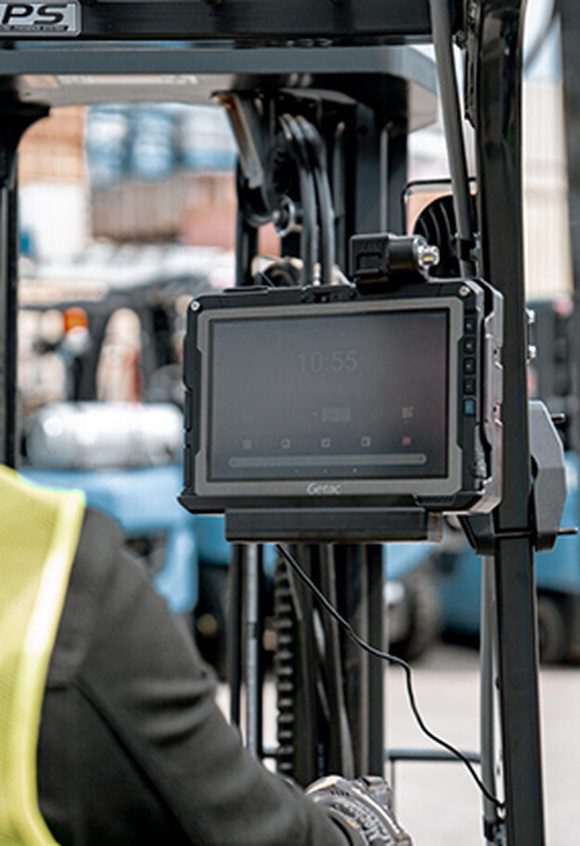
Getac rugged tablets are compatible with Havis, Gamber-Johnson, and RAM Mounts docking and mounting systems, covering in-cab tractors, yard trucks, forklifts, and fixed dispatch consoles.
A tablet that does not mount is a tablet a driver holds, drops, and replaces. Fleet installs also have to survive a cab that vibrates for ten hours a day, and hardware that moves between vehicles when a contract turns over.
The dock carries power, so the device comes out of one vehicle and into the next without re-rigging. Getac’s professional services team consults on vehicle installation as part of a fleet deployment, covering mounting layout, power setup, and dock integration.
How Do Transportation & Logistics Operations Deploy Getac Rugged Devices?
What Rugged Tablet Do Terminal and High-Volume Dispatch Operations Use?
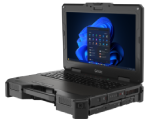
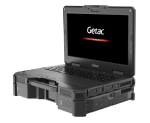
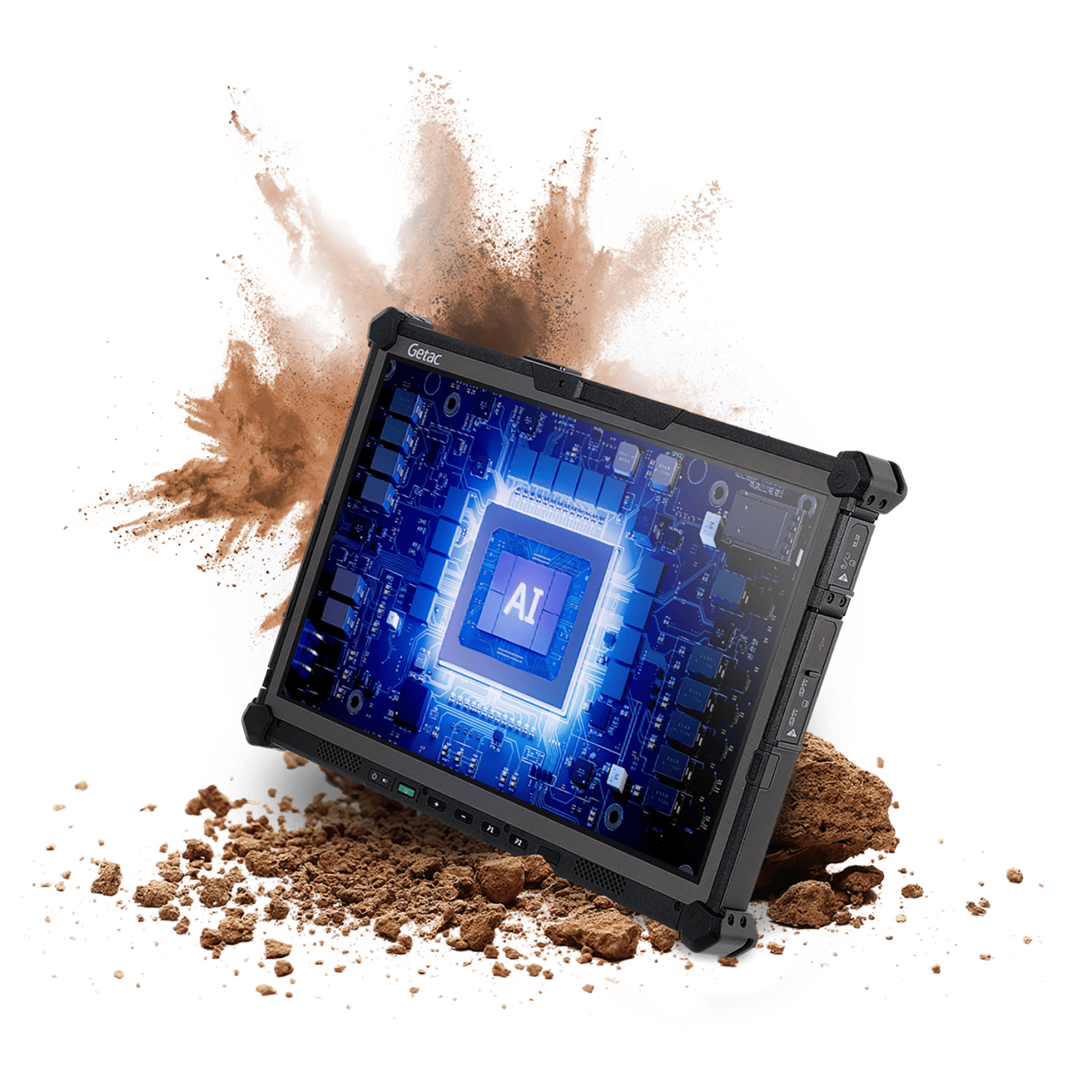
Terminals and high-volume dispatch centers run the heaviest data workloads across the operation, with staff moving between dock doors, yards, and staging in a single shift. They need a vehicle-mounted tablet with a display large enough to run the TMS and dispatch systems at once, and a battery system that handles shift changes without taking the console offline. The Getac G140 fully rugged tablet is built for that role.
The 14-inch, 1,000-nit LumiBond display is wide enough to run the TMS and dispatch side by side and bright enough to read from the cab to the yard, so nobody closes one system to open another. Hot-swappable dual batteries keep the console live through shift change. Smart Touch handles glove input without switching modes between heated docks and outdoor staging, Wi-Fi 7 with optional 5G holds the connection across large terminals, and AMD Ryzen AI processors deliver up to 50 NPU TOPS for on-device AI workloads. Havis, RAM Mounts, and Gamber-Johnson docking and mounting systems cover yard trucks, over-the-road tractors, and fixed dispatch consoles.
What Rugged Windows Tablet Do Terminal and Dock Teams Use?
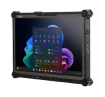
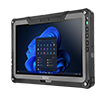
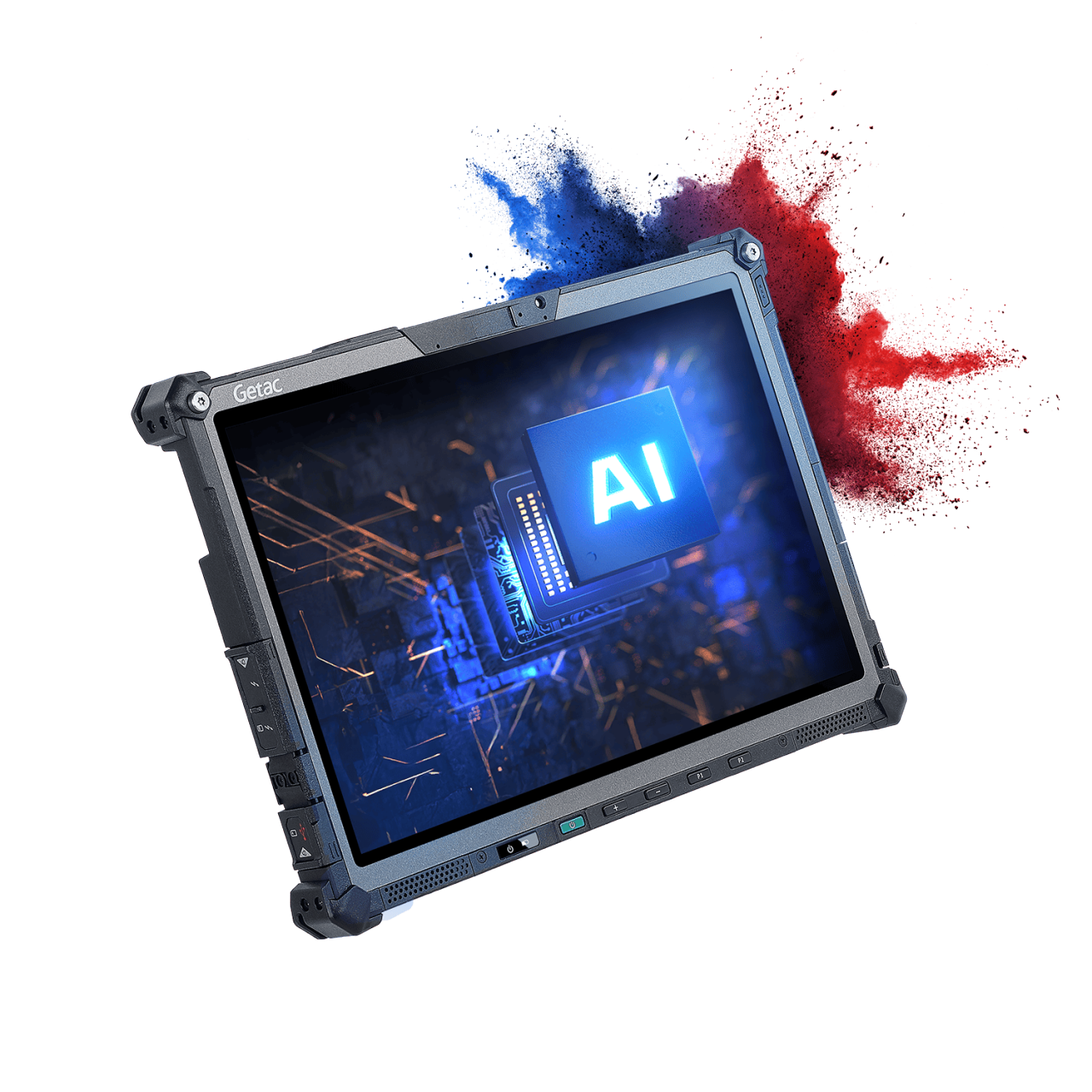
Terminal and dock teams running Windows software use the Getac F120, a 12.2-inch fully rugged Windows 11 tablet on Intel Core Ultra 200V, certified to MIL-STD-810H and IP66. It runs TMS, ERP, and inspection applications without reconfiguration and hot-swaps batteries through shift change. A dock coordinator's day runs from a vibrating cab to a dusty dock to a refrigerated trailer, and the device has to hold up across all three.
The F120 is a full Windows 11 platform, not a mobile OS with a compatibility layer, so the TMS, ERP, and inspection software already running on the desktop runs here the same way. The 12.2-inch, 1,200-nit LumiBond display stays legible from the dock to the cab, and touch, glove, and stylus modes cover the move from a bare-handed console to a cold trailer. Hot-swap batteries keep the device online through shift change. 4G and 5G LTE with Wi-Fi and optional dual-SIM hold coverage across cab, dock, and yard, and Havis, RAM Mounts, and Gamber-Johnson docking and mounting systems handle in-cab and console installation.
What Rugged Android Tablet Do In-Cab Drivers Use?
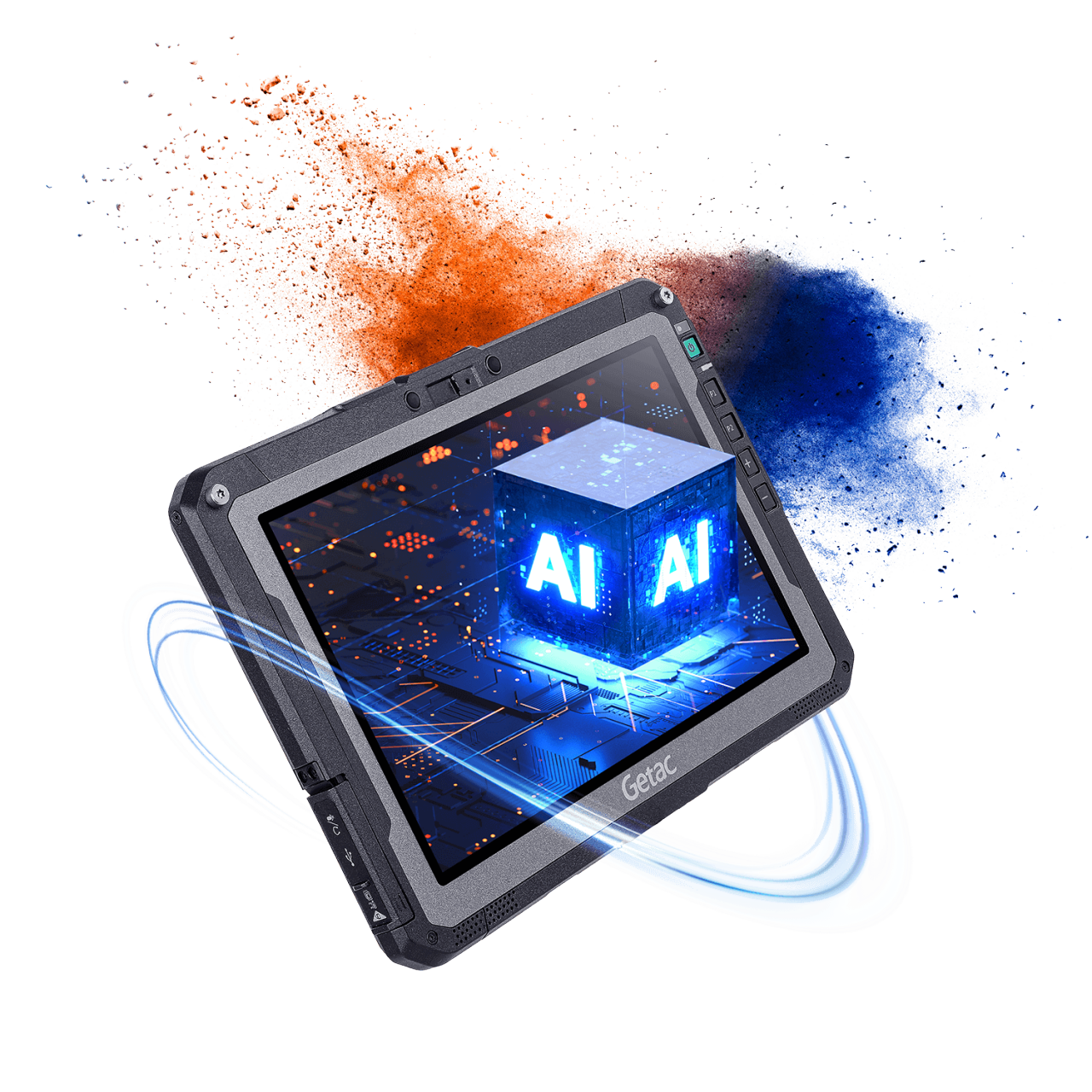
In-cab drivers use the Getac ZX10, a fully rugged 10-inch Android tablet certified to MIL-STD-810H and IP66, Android Enterprise Recommended, and booting in under a minute. It runs navigation, ELD and HOS logging, and dispatch on one device and scans barcodes at pickup and delivery. A driver starts and stops a dozen times a shift, and every one of those is dead time if the tablet has to wake up first.
The ZX10 is the lightest 10-inch fully rugged Android tablet on the market, which matters because a driver holds it, not a dock. It boots in under a minute, so the cab is working before the truck is. Input adjusts between touch, glove, and stylus as drivers move between a heated cab and a cold trailer, and the sunlight-readable LumiBond display stays usable from the cab to the yard. Android Enterprise Recommended means fleet MDM, app management, and staging follow the same process the rest of the fleet already uses. 4G and 5G LTE with Wi-Fi, dual-SIM, and embedded modem options hold coverage on the highway and in the yard.
What Compact Rugged Android Tablet Do Last-Mile and Cold-Chain Drivers Use?
At 590g the ZX80 works one-handed for a full route, which is the difference between a device a driver carries and a device a driver leaves in the cab. IP67 means submersion, not splash resistance, so washdown zones and a dropped tablet in standing water at the dock are not incidents. MIL-STD-810H covers the drops that come with a hundred stops a day and the temperature swing from a refrigerated trailer to an ambient loading dock. Touch, glove, and stylus input all work through that transition, and the ZX80 runs the Android navigation, proof-of-delivery, and scanning applications delivery teams are already standardized on.
What Rugged Windows Tablet Do Drivers Running In-Cab Windows Software Use?
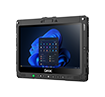
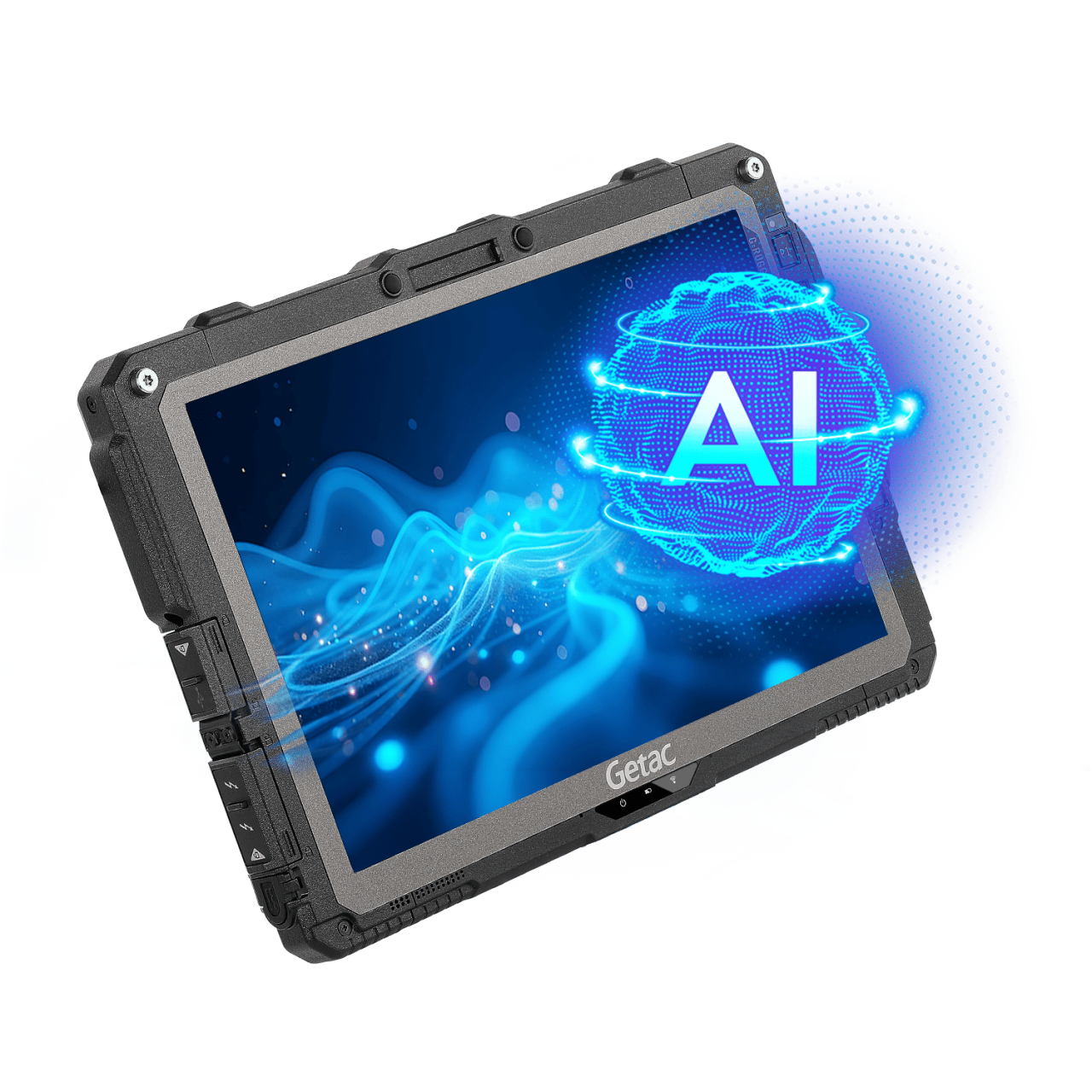
Drivers and inspectors running Windows-based ELD, DVIR, and TMS software in the cab use the Getac UX10, a Copilot+ PC rugged tablet powered by Intel Core Ultra 200V processors with Intel AI Boost NPU, Wi-Fi 7, and MIL-STD-810H certification. A pre-trip inspection happens outside the truck in whatever weather the yard has that morning, and the device has to come back inside and pick up the dispatch queue without a reboot.
How Does the UX10 Handle a Full Over-the-Road Shift?
Route optimization, telematics dashboards, and inspection applications run on-device without waiting on a connection. The UX10 supports up to 32GB LPDDR5X memory, so a TMS client and a live telematics feed run at the same time without slowdown, and Wi-Fi 7 holds the connection across terminals and yards without the weight and cost of a full rugged laptop.
What Happens When a Logistics Operation Standardizes on Rugged Hardware?
For most large carriers the device problem isn't one terminal, it's the whole network. Different hardware at every distribution center, no standard across sites, and nobody owning the device environment. The result is a reactive IT model, operators stranded waiting on a 15-minute boot, and equipment pulled out of service every time a device fails.
A major transportation and logistics carrier with more than 400 warehouses nationwide proved the model out. The carrier outfitted its entire fleet of more than 10,000 forklifts with Getac ZX10 fully rugged Android tablets, paired with a docking station, a custom mounting solution, and a hub that eliminated device replacement and lift-scale recalibration costs. With boot time cut from 15 minutes or more to under one minute, deployXpress managing configuration across various forklift brands, and dual-SIM and embedded-modem redundancy keeping every truck connected, the projected ROI came in at less than one year, with recovered man-hours alone covering the entire cost of the deployment.
Which Transportation & Logistics Segments Use Getac Rugged Devices?
Every segment runs different workflows, different software platforms, and different field conditions. Drivers need in-cab navigation and proof-of-delivery. Cold-chain fleets need IP-rated devices that survive refrigerated trailers. Terminals and ports need large-display tablets for dispatch and yard management at fleet scale. Getac's rugged Windows and Android portfolio covers every role across every segment, with vehicle docking compatibility, MDM support, and Bumper-to-Bumper warranty coverage operations depend on at fleet scale.
Last-Mile & Parcel Delivery — What Handles High-Volume Stops?
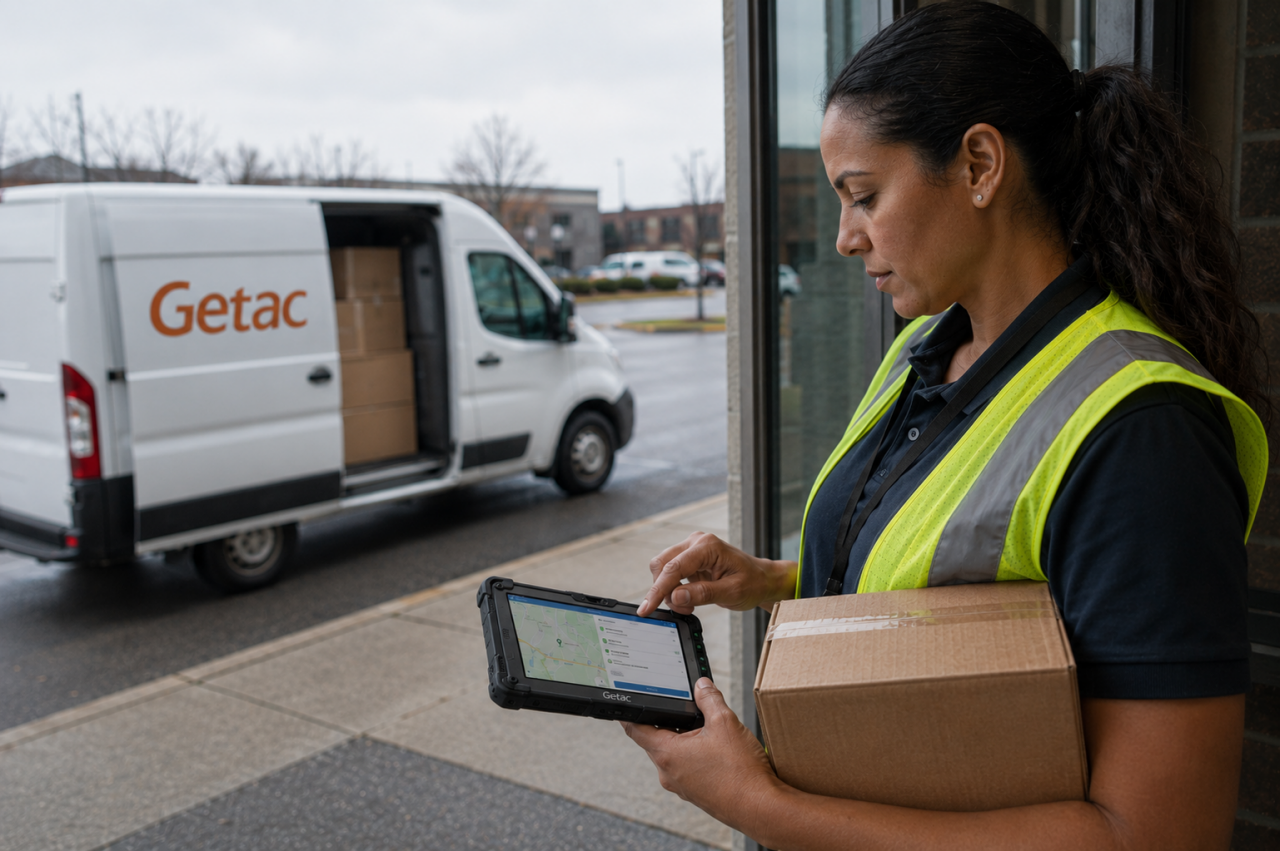
The Getac ZX80 handles high-volume last-mile and parcel routes. It is an 8-inch fully rugged Android tablet weighing 590g, certified to MIL-STD-810H and rated IP67 for submersion, so a courier runs navigation, barcode scanning, signature capture, delivery photos, and real-time proof-of-delivery sync one-handed at the door.
A courier stop lasts about thirty seconds. A 10-inch tablet is one more thing to put down before picking up the freight, and a consumer device in a protective case cracks on the first drop at a doorstep. The ZX80 is the most compact fully rugged Android tablet in the Getac portfolio, which is what makes it a device a driver carries rather than one a driver leaves in the van.
Its sunlight-readable LumiBond display stays usable on a bright doorstep and in a dim stairwell, and touch, glove, and stylus input all work without switching modes between the vehicle and the delivery point. IP67 means submersion rather than splash resistance, so rain on the route and a dropped tablet in standing water are not incidents.
LTL & Long-Haul Trucking — What Keeps Drivers Compliant and Connected?
In-cab drivers on LTL and long-haul routes use the Getac ZX10, a 10.1-inch fully rugged Android tablet certified to MIL-STD-810H and IP66, running Android 15, Android Enterprise Recommended, and booting in under a minute. It runs ELD and HOS logging, navigation, and dispatch on one device, with 4G LTE and 5G Sub-6 plus dual-SIM to hold coverage across highways and rural corridors.
A driver starts and stops a dozen times a shift, and every one of those is dead time if the tablet has to wake up first. The ZX10 is the lightest 10-inch fully rugged Android tablet on the market, which matters because a driver holds it, not a dock, and sub-one-minute boot means the cab is working before the truck is.
It mounts to Havis, RAM Mounts, and Gamber-Johnson vehicle docks for in-cab installation, and touch, glove, and stylus input all work as drivers move between a heated cab and a cold trailer. Fleets standardized on Windows software in the cab run the Getac UX10 instead, a Copilot+ PC rugged tablet on Intel Core Ultra 200V with Wi-Fi 7 for ELD, DVIR, and TMS applications.
3PL & Freight — What Deploys Fast Across Multiple Sites?
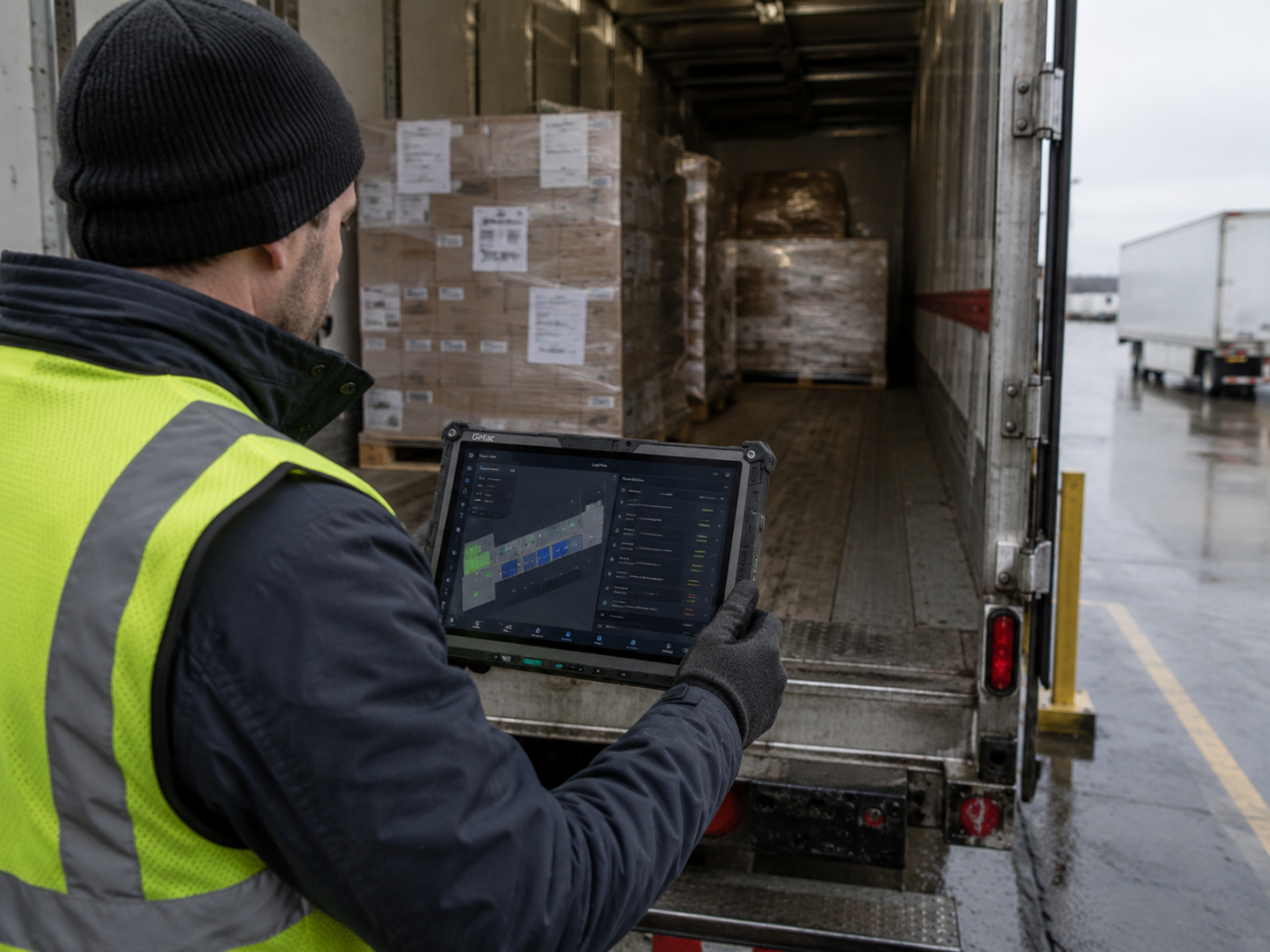
Third-party logistics operators verifying trailer loads at the dock use the Getac F120, a 12.2-inch fully rugged Windows 11 tablet on Intel Core Ultra 200V, certified to MIL-STD-810H and IP66 with a 1,200-nit LumiBond display. It runs TMS, ERP, and inspection applications without reconfiguration, so load verification, trailer checks, and exception handling happen at the dock door rather than back at a desk.
Contracts turn over quickly in 3PL, and hardware has to move with them. Getac docking and mounting systems let a device come out of one vehicle and into the next without re-rigging, and deployXpress configures Android devices at scale so a new site rolls out in days rather than weeks.
The F120 hot-swaps batteries through shift change, so a dock coordinator is not tethered to a charger between trailers, and the 1,200-nit display stays legible from a dim trailer interior to a bright dock apron. For Android fleets, the same docking approach applies to the ZX10 with deployXpress handling configuration across sites.
Cold-Chain Distribution — Which Device Survives Refrigerated Trailers?
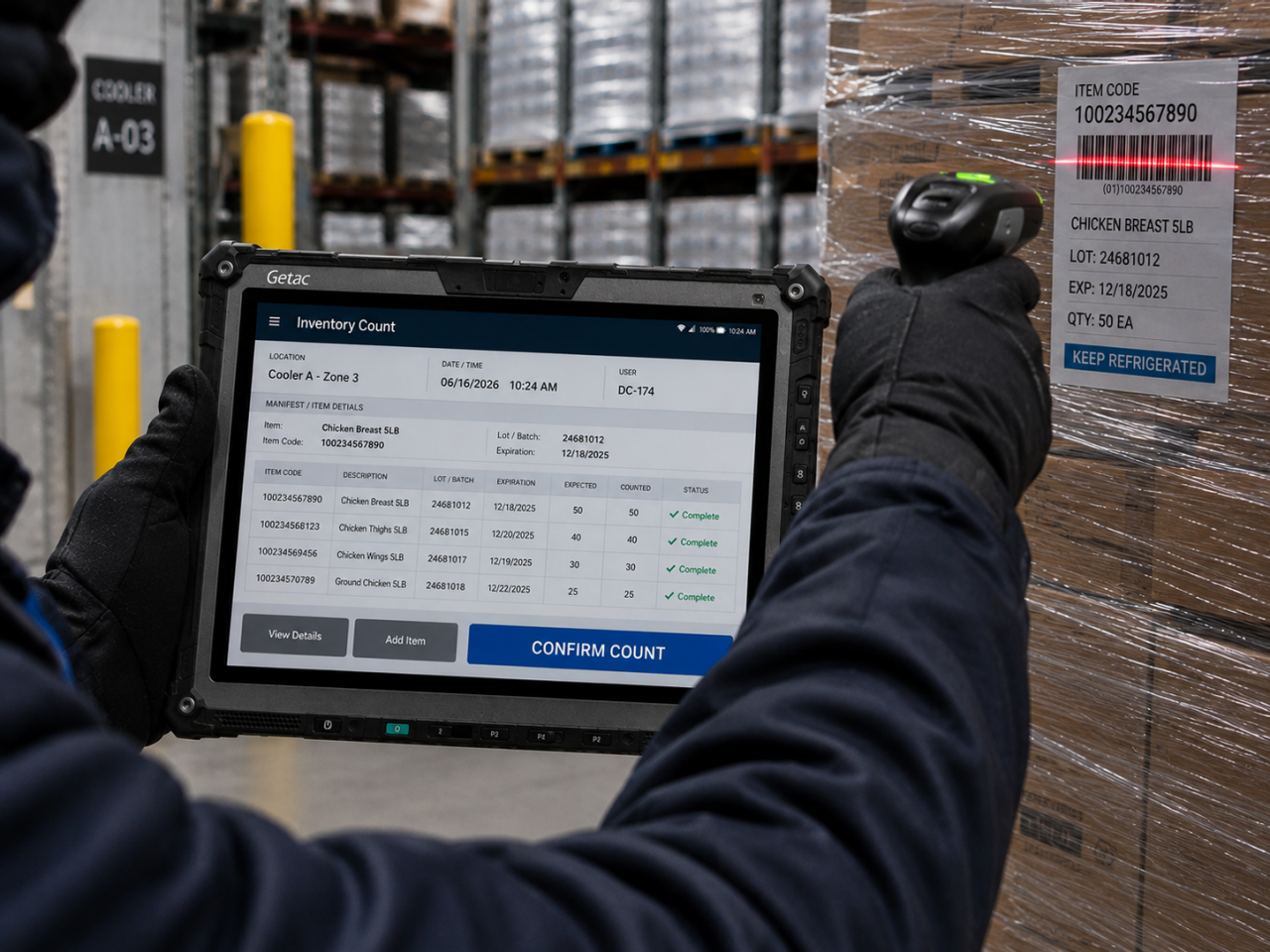
Cold-chain scanning and proof-of-delivery run on the Getac ZX80, an 8-inch fully rugged Android tablet weighing 590g, certified to MIL-STD-810H and rated IP67 for submersion. It handles refrigerated-to-ambient transitions, washdown zones, and glove input, so drivers keep scanning freight without stopping to take a glove off.
A cold-chain route moves a device between a refrigerated trailer, an ambient dock, and outdoor weather several times an hour. Condensation is what kills consumer devices in that cycle, and a warranty that excludes liquid ingress makes every failure a replacement rather than a repair.
IP67 means submersion rather than splash resistance, so a washdown zone and a dropped tablet in standing water are not incidents. MIL-STD-810H covers the temperature extremes and the drops that come with the route, and touch, glove, and stylus input all work through the transition without switching modes.
Rail, Port & Intermodal — What Holds Up in the Yard?
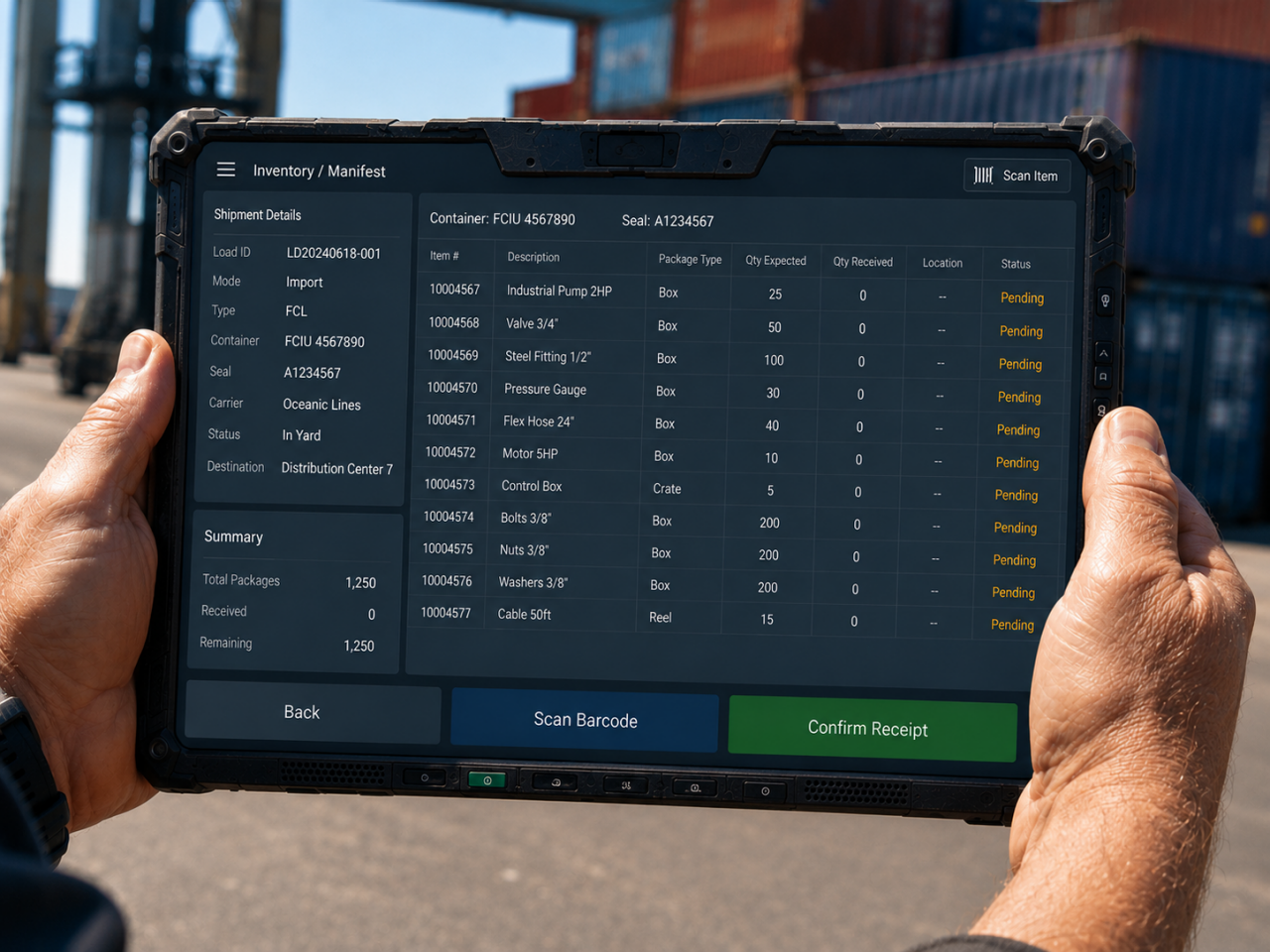
Rail, port, and intermodal yards run the Getac G140, a 14-inch fully rugged tablet certified to MIL-STD-810H and IP66 with a 1,000-nit sunlight-readable LumiBond display. It handles gate check-in and check-out, container and trailer scanning, and GPS yard navigation across large outdoor terminals, with hot-swappable dual batteries that keep it live through shift change.
Yard work is outdoors in whatever the weather is doing, and a screen a driver cannot read in direct sun stops the gate. The G140 display is bright enough to work from the cab to the container stack, and Smart Touch handles glove input without switching modes between a heated cab and an exposed yard.
Wi-Fi 7 with optional 5G holds the connection across large terminals where coverage is uneven, AMD Ryzen AI processors deliver up to 50 NPU TOPS for on-device workloads, and Havis, RAM Mounts, and Gamber-Johnson mounting systems cover yard tractors, hostlers, and fixed gate consoles.
What Support and Warranty Coverage Comes With a Getac Fleet Deployment?
In logistics operations, device downtime means drivers stranded without navigation or ELD, deliveries logged on paper, and vehicles pulled out of service waiting on a swap. Getac rugged devices and support programs are designed to keep your fleet running, not recovering from failures.

Comprehensive Warranty & Coverage
- Total Warranty Cover: Includes accidental damage to reduce repair costs and downtime.
- Bumper-to-Bumper Protection: Fixed costs with no surprises, giving you peace of mind.
- Fast Replacement: If we can't repair your device, we'll replace it with one of equal or better specs.

Advanced Service & Repair Solutions
- Getac Service Portal: Track and manage repairs from return to delivery. Watch the walkthrough (13 min) ›
- Return-to-Base Service: 3 years of repairs with genuine parts and qualified technicians.
- Self-Maintainer Program: Perform in-house warranty repairs.

Built for Uptime
- BIOS and firmware updates to address vulnerabilities with Intel and Insyde Software.
- Security updates to safeguard your systems and keep operations secure.

Additional Services for Maximum Control
- Drivers & Documents: Quick access to essential updates.
- Getac Recovery Service: Simple solutions to restore device functionality.
- Extended Warranty Options: Add accidental damage or Keep Your SSD Warranty for extra peace of mind.
With Getac, you’re not just buying a device — you’re investing in reliable tools and support to help you maximize uptime for your fleet operations.
How Does Getac Lower Total Cost of Ownership Across a Fleet?
Fleet total cost of ownership is not settled on the purchase order. It is settled afterward, in repair invoices, replacement cycles, and the hours IT spends re-provisioning units one at a time. Getac reduces total cost of ownership through lower device failure rates, Bumper-to-Bumper warranty coverage that includes accidental damage, and the Self-Maintainer Program that lets fleet IT teams handle in-house warranty repairs at scale. Android devices also cut the OS licensing and patching overhead that Windows fleets carry across thousands of units.
Rugged devices are transforming fleet and logistics operations by integrating with network management platforms, boosting operator productivity with real-time data, and reducing device failure risks.
The IDC InfoBrief explores these challenges, cost benefits, and tips for picking the right vendor.
Key insights include:
- Cutting costs with better TCO.
- Improving sustainability through energy and waste management.
- Selecting the right vendor for long-term success.

Frequently Asked Questions
The following questions and answers cover the most common queries from fleet IT directors, logistics operations managers, terminal and dispatch supervisors, and procurement teams evaluating rugged device solutions for in-cab computing, last-mile delivery, terminal and yard operations, and fleet-scale device management.
What rugged tablets work with ELD, telematics, and dispatch software?
Getac rugged Android and Windows tablets are compatible with major ELD, telematics, TMS, and dispatch platforms, with vehicle-dock mounting via Havis and Gamber-Johnson systems for in-cab installation.
What Getac devices are best for last-mile and delivery drivers?
Compact, handheld-friendly rugged Android tablets give drivers a sunlight-readable, drop-tested device for navigation, scanning, and proof-of-delivery. All are certified to MIL-STD-810H from the chassis up.
Does Getac support in-cab and vehicle-mounted installations?
Yes. Getac rugged tablets are compatible with Havis, RAM Mounts, and Gamber-Johnson vehicle docking systems, and Getac's professional services team provides vehicle installation consultation as part of fleet deployment, covering mounting layout, power setup, and dock integration.
Can Getac devices run MDM platforms for fleet-wide device management?
Yes. Getac Windows and Android rugged devices are compatible with enterprise MDM platforms for remote management, application deployment, policy enforcement, and fleet monitoring, and deployXpress configures Android devices at scale for fast rollout across multiple sites.
What certifications do Getac transportation devices carry?
Getac rugged devices are certified to MIL-STD-810H for drop, vibration, temperature, humidity, and altitude resistance, with IP66/IP67 ratings for dust and water ingress. All support 4G/5G LTE and Wi-Fi connectivity. Contact Getac to confirm specifications for the models under evaluation.
How does Getac reduce total cost of ownership for fleets?
Through lower device failure rates, Bumper-to-Bumper warranty coverage that includes accidental damage, and the Self-Maintainer Program for in-house repairs. Android devices also cut OS licensing and patching overhead, and faster boot returns lost hours to every route.
What happens if a Getac device breaks in the cab or on the road?
Getac's Bumper-to-Bumper warranty covers accidental damage, including drops, vibration, and liquid ingress. The Self-Maintainer Program lets qualified fleet IT teams perform in-house warranty repairs, and advanced exchange is available for operations that cannot tolerate individual device downtime.
What rugged tablet is best for cold-chain and refrigerated delivery?
Compact rugged Android tablets rated IP67 and certified to MIL-STD-810H handle refrigerated-to-ambient transitions, washdown zones, and glove input, so cold-chain drivers keep scanning and capturing proof of delivery without the device failing in the cold.
How do rugged tablets reduce driver downtime in transportation and logistics?
Rugged tablets boot in under a minute instead of the 15 minutes a failing consumer device can take, survive drops and vibration in the cab, and hold connectivity across highways and dead zones, so drivers spend the shift running stops instead of waiting on hardware.
What is the difference between a fully rugged tablet and a ruggedized consumer device?
A fully rugged tablet is engineered from the chassis up to MIL-STD-810H and IP standards for drops, vibration, dust, water, and temperature extremes. A ruggedized consumer device is a standard tablet in a protective case that still fails under real fleet conditions and voids its warranty on accidental damage.
Fill Out the Form Below to Be Contacted by a Transportation & Logistics Specialist