





























EPEAT
EPEAT is a leading global ecolabel for electronics, managed by the Global Electronics Council (GEC). EPEAT certification signifies a product’s adherence to rigorous criteria related to climate, circularity, reduction of chemicals of concern, and responsible supply chains.
Getac is dedicated to achieving the highest standards of environmental performance and consistently aims for EPEAT certification across our product lines. Registering for the Bronze tier indicates that the products meet all required criteria. Obtaining the Silver tier represents meeting all required criteria and attainment of at least 50% of the optional points. Achieving the Gold tier demonstrates compliance with all required criteria plus achievement of at least 75% of the optional points.
Supporting documentation on the relevant criteria encompassing ESG, sustainable supply chain management, and green product design can be found in the content below. To explore our EPEAT-registered products, please visit https://www.epeat.net/.
Chapter 4 Climate Change Mitigation
4.1.1 Product carbon footprint disclosure and assurance
Getac’s EPEAT-registered products undergo third-party-verified product carbon footprint (PCF), evaluating CO2 equivalent emissions from extraction of raw materials and manufacturing through end-of-life (Cradle to Grave) according to the ISO 14040, ISO 14044, and ISO 14067 standards. The PCF reports are updated every 3 years, and the latest reports are available at Environmental Protection.
4.1.2 Corporate GHG inventory
Getac conducts corporate greenhouse gas (GHG) inventories annually covering Scope 1, 2, and 3 emissions as defined by the GHG Protocol. The results of the GHG inventories are third-party verified. Please refer to 2025 Corporate GHG inventory.
4.1.3 Product transport carbon footprint and goal
Getac conducts annual product transport carbon footprint assessments, covering well-to-wheel GHG emissions from all modes of freight transportation used, in accordance with the Global Logistics Emissions Council (GLEC) Framework. Additionally, Getac sets a GHG emission reduction goal and reports progress toward achieving it each year. The results of these transportation carbon footprint assessments are verified by an independent third party every 3 years, please refer to Environmental Protection for details.
4.1.4 Product LCA and 3rd party review, publicly available
Getac conducts life cycle assessments (LCA) for each product type (notebook and tablet) across all stages of the product life cycle, from extraction of raw materials and manufacturing through end-of-life (Cradle to Grave). The LCAs are performed in accordance with ISO 14040 and ISO 14044, and the reports are verified by an independent third party and updated every 3 years. The latest reports are available at Environmental Protection.
4.2.1 Manufacturer GHG reduction target aligned with climate science
Getac has set and implemented science-based GHG reduction targets aligned with the 1.5°C ambition, and approved by the Science Based Targets initiative (SBTi). For further information, please refer to the Target dashboard - Science Based Targets Initiative. Our annual progress reports are available at Environmental Protection.
4.3.4 Facility energy reporting
Getac discloses annual energy consumption data for its final assembly facility and key component facilities, representing 25% of production spend for this criterion. Please refer to Facility Energy Reporting for details.
Chapter 5 Sustainable Use of Resources
5.2.1 Critical mineral content disclosure
Critical minerals, such as Bismuth and Antimony, are commonly found in rechargeable batteries, display panels, and other components. Getac discloses the content of critical minerals in these components of notebook and tablet products at Getac EPEAT Substance Disclosure Report (notebook, tablet).
5.3.1 Firmware or Operating System updates
To enable product longevity, user security, and safety, Getac provides firmware updates for a minimum of 5 years after the end of production of both the notebook and tablet products. Please refer to Support Service Introduction for the declaration and instructions on accessing the latest firmware.
5.4.3 & 5.4.4 Software parts pairing for notebook computers, tablets and mobile phones
Getac notebook and tablet products do not use parts pairing – that is, numerical authorization keys and serial numbers - for part replacements. If customers purchase Getac licensed software, such as Essential Apps and Essential Control, the licenses can be managed as needed. Please visit Support Service Introduction for details.
5.5.1 Availability of repair services and replacement components
Getac offers repair services and replacement components for at least 5 years from the date of end of placement on the market for both notebook and tablet products. For slate tablets, Getac extends this support period to 7 years. Please refer to Support Service Introduction for the declaration and instructions on accessing repair services and replacement components.
5.5.2 Publicly available repair information for notebook computers, tablets and mobile phones
Getac discloses repair information including disassembly and reassembly instructions, available replacement components, maintenance procedures, and troubleshooting instructions at Product End-of-Life Instructions.
5.5.3 Information on reuse and recycling
Getac discloses product information on materials requiring selective treatment, as identified in WEEE Directive 2012/19/EU Annex VII, for use by third-party reuse and recycling organizations at Product End-of-Life Instructions for all notebook and tablet products. The information is available for at least 7 years following the end of production of the product.
5.6.1 & 5.6.2 Secure data deletion for circularity
Getac’s EPEAT-registered products offer user data sanitization and can achieve purge level in accordance with NIST SP 800-88. Storage device contained in all EPEAT-registered products is SSD, except ZX10 and ZX80 are using UFS. For instructions on secure date deletion, please refer to Secure Erase Guideline.
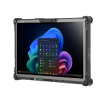
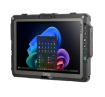
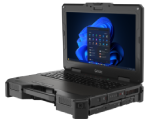
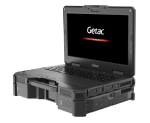
Affected Products: B360, B360 Pro, S410, S510, V110, K120, F110, UX10, ZX10, and ZX80
5.7.1 Provision of product take-back service
Getac is committed to minimizing environmental impact and promoting a circular economy through our Take-Back Program, which prioritizes reuse, refurbishment and then materials recovery, before considering energy recovery and/or disposal. Please visit Take-Back Program for instructions on how to use the program.
Chapter 6 Reduction of Chemicals of Concern
6.1.3 Conformance with supply chain communication provisions of European Union REACH Regulation
Getac discloses and updates the content of REACH SVHCs in notebook and tablet products at Getac EPEAT Substance Disclosure Report (notebook, tablet).
6.2.2 Disclosure of declarable substances
Getac discloses and updates the content of declarable substances in notebook and tablet products at Getac EPEAT Substance Disclosure Report (notebook, tablet).
6.2.5 Record and public disclosure of PFAS
Getac discloses the PFAS contained in notebook and tablet products at Getac EPEAT Substance Disclosure Report (notebook, tablet).
6.3.3 Making safer substance use hazard assessments publicly available
All plastic parts ≥ 25 g of Getac’s EPEAT-registered products do not use plasticizers and only use one type of flame retardant that meet benchmark 3 in GreenScreen®. Please refer to Getac EPEAT Substance Disclosure Report (notebook, tablet) for the disclosure of the flame retardant, and its assessment method and result.
6.4.1 Manufacturer program for reduction of high priority process chemicals
Getac collects process chemical inventory from suppliers and facilities to identify any high priority process chemicals used during the manufacturing of Getac notebook and tablet products. Please refer to Getac Report on High Priority Process Chemical Management to learn about the program.
Chapter 7 Responsible Supply Chains
7.1.2 Supplier code of conduct requirements for labor and occupational health and safety
Getac has a Supplier ESG Code of Conduct conveying ESG requirements including labor rights and occupational health and safety requirements and it is in line with RBA code of conduct. The Supplier ESG Code of Conduct is communicated to directly contracted suppliers through the Letter of Undertaking for Environmental and Social Responsibility, and the suppliers are required to sign the Letter committing to building a responsible supplier chain together. The Supplier ESG Code of Conduct is available at here.
7.1.3 Required – Social responsibility performance audits of high-risk suppliers
The Summary of Audit and Corrective Action Report regarding assessments conducted within the supply chain is available here.
7.1.4 Optional – Improving Supply Chain Quality and Transparency
The Summary Report on worker engagement and labor conditions Improvement for prioritized supplier facilities is available here.
The list of supplier facilities required under Criterion 7.1.4 is available here.
7.1.5 Optional – Suppliers details for worker engagement
The Summary Report on activities undertaken to engage workers in improving labor conditions in the workplace for Prioritized Supplier facilities is available here.
7.3 Responsible mineral sourcing
Getac has established a responsible mineral due diligence measures for 3TG (gold, tungsten, tin, tantalum) and cobalt. The processes align with the OECD Due Diligence Guidance for Responsible Supply Chains of Minerals from Conflict-Affected and High-Risk Areas. Getac conducts the CMRT and EMRT survey annually and reviews the submitted data from suppliers. Conformance is verified through reference to the list of conforming smelters and refiners published by the RMI. The policy and the list of identified smelters and/or refiners are available at Responsible Minerals Sourcing Policy. Please visit the website for more information.