
















Key Takeaways
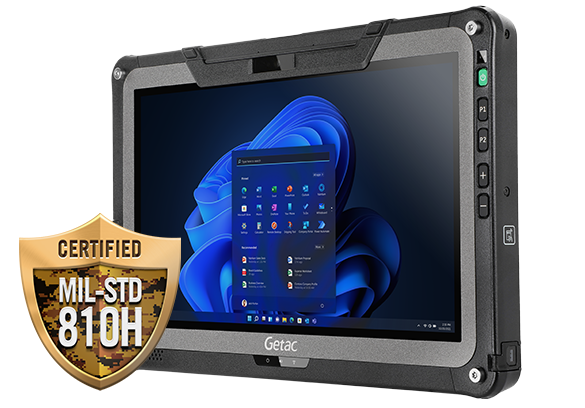
MIL-STD-810H is a US Department of Defense (DoD) test method standard for environmental stress. It contains 29 laboratory test methods (Methods 500 to 528) covering conditions such as temperature, shock, vibration, dust and water.
MIL-STD-461G is a DoD standard for electromagnetic interference (EMI). It defines 19 test requirements in four groups: conducted emissions (CE), conducted susceptibility (CS), radiated emissions (RE) and radiated susceptibility (RS).
Neither standard works as a single pass/fail certificate. MIL-STD-810H asks users to tailor tests to how a product will be used, and MIL-STD-461G assigns requirements by platform and equipment type.
Rugged laptops and tablets are typically tested against a selected set of methods, not every method in the standard. Getac's test coverage also varies by model.
To compare devices, ask for the test methods, procedures and results for the exact model and configuration you plan to buy.
What Is MIL-STD?
The Military Standard (MIL-STD), or Defense Standard, was established after WWII to provide uniform requirements and ensure interoperability for the military and its secondary industries, with an explicit focus on engineering and technical requirements, processes, procedures, practices, and methods. First used by branches of the military, MIL-STD test methods are now also widely used by commercial manufacturers to evaluate how products hold up in demanding conditions.
What Does MIL-STD Certification Mean?
The US Department of Defense (DoD) publishes MIL-STD test standards, but there is no single "MIL-STD certificate" that applies to every product. MIL-STD-810H is written as a tailoring guide. According to the standard's own summary, it does not impose design or test specifications. Instead, the people specifying or building a product choose the test methods, procedures and test levels that match how the product will be used.
When a laptop or tablet is described as MIL-STD-810H certified, it means the device was tested against a selected set of methods from the standard, either in-house or by a third-party lab. Two devices with the same claim can have been tested in quite different ways. The main differences are:
Which methods were run
MIL-STD-810H contains 29 test methods, and many apply only to specific military platforms, such as shipboard equipment or externally carried aircraft stores.
Which procedure and test levels were used
For example, the transit drop procedure in Method 516 (Shock) calls for 26 drops. The standard allows those drops to be performed on a single unit or divided across several units, which affects what the result tells you.
Whether results are reported for every method tested
A claim may list the methods that were run without stating the outcome of each one.
Which model and configuration were tested
Results apply to the model and configuration that went through testing, not automatically to every variant.
The best way to know for sure is to ask for the test methods, procedures and results for the exact model and configuration you plan to buy.
How Does MIL-STD-810H Compare to MIL-STD-461G?
The two most common MIL-STD standards for rugged tablets and laptops are MIL-STD-810H (which replaced MIL-STD-810G) and MIL-STD-461G. MIL-STD-810H focuses on environmental conditions. Extreme temperature, moisture, dust, and shock are a few of the 29 test methods it contains. A device tested to selected MIL-STD-810H methods has been evaluated against those specific conditions, such as heat, water and dust exposure, or shock.
MIL-STD-461G focuses on electromagnetic (EM) compatibility, as detecting EM interference or rogue signals can be critical to safety or communications secrecy in certain industries. MIL-STD-461G evaluates in four specific areas:
- Radiated emissions
- Conducted emissions
- Radiated susceptibility
- Conducted susceptibility
MIL-STD-810H vs. MIL-STD-461G
| MIL-STD-810H | MIL-STD-461G | |
|---|---|---|
| What it tests | Environmental stress: temperature, pressure, water, dust, shock, vibration and more | Electromagnetic compatibility: emissions from the device and its tolerance to interference |
| Full title | Environmental Engineering Considerations and Laboratory Tests | Requirements for the Control of Electromagnetic Interference Characteristics of Subsystems and Equipment |
| Current version | MIL-STD-810H, 31 January 2019, with Change Notice 1, 18 May 2022 | MIL-STD-461G, 11 December 2015 |
| Number of tests | 29 test methods (Methods 500 to 528) | 19 test requirements in four groups (CE, CS, RE, RS) |
| How tests are selected | Tailored to the product's expected life cycle and use | Applied by platform and equipment type |
| Example tests | Low Temperature (502), Rain (506), Sand and Dust (510), Shock (516) | CE102, CS114, RE102, RS103 |
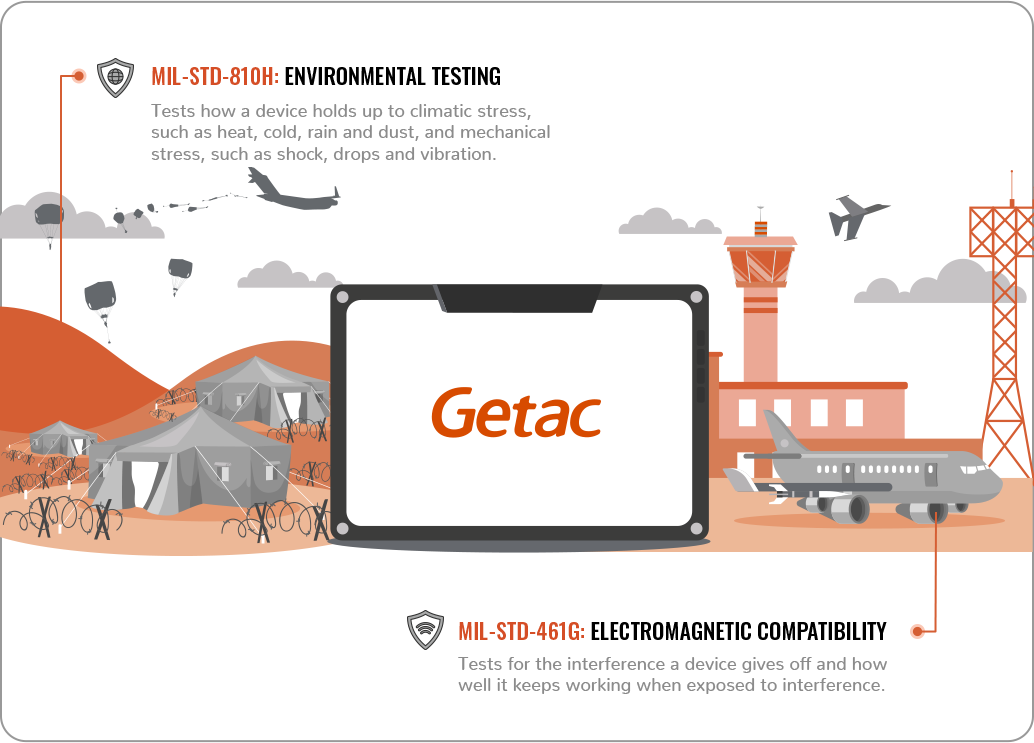
MIL-STD-810H vs. MIL-STD-461G at a glance. MIL-STD-810H covers environmental stress such as temperature, moisture, dust and shock. MIL-STD-461G covers electromagnetic compatibility across radiated emissions, conducted emissions, radiated susceptibility and conducted susceptibility.
What Is MIL-STD-810H?
MIL-STD-810H is a DoD test method standard that focuses specifically on environmental stress and is widely used to test tablet and laptop ruggedness. It was issued on 31 January 2019 and updated with Change Notice 1 on 18 May 2022. It replaced MIL-STD-810G, which was first issued in 2008 and updated with its own Change Notice 1 in 2014. Part Two of the standard contains 29 laboratory test methods, numbered 500 to 528.
Test Methods
Issued
Updated
MIL-STD-810H Test Methods 500 to 528
| Method | Test | What it evaluates |
|---|---|---|
| 500 | Low Pressure (Altitude) | Tests whether a product can withstand rapid pressure changes or operate in low-pressure settings. |
| 501 | High Temperature | Obtains data on the safety, integrity, and performance of a device in high temperatures. |
| 502 | Low Temperature | Assesses effects of low temperatures on equipment, materiel safety and integrity, and performance during storage, operation, and manipulation. |
| 503 | Temperature Shock | Determines a device's ability to withstand sudden, drastic changes in temperature without deteriorating in performance or being physically damaged. |
| 504 | Contamination by Fluids | Tests temporary exposure to contaminating fluids, occasional, intermittent, or over extended periods, to assess the impact on materiel. |
| 505 | Solar Radiation (Sunshine) | Determines the heating effects of sunshine or solar radiation on materiel, and identifies the effects of exposure (photodegradation). |
| 506 | Rain | Addresses protection from water (spray, dripping water, rain), the effectiveness of covers, cases, seals, and water removal systems, and a device's ability to retain performance during and after exposure. |
| 507 | Humidity | Evaluates the resistance and effects of warm, humid atmospheres on materiel. |
| 508 | Fungus | Determines material susceptibility to fungal growth, growth speed, and how growth affects the device, mission, and safety; also tests field storage and cleaning processes. |
| 509 | Salt Fog | Assesses the effectiveness of finishes and protective coatings, and the effects of salt on the physical and electrical portions of a device. Note: Salt fog treatment is an option on selected Getac models only. |
| 510 | Sand and Dust | Evaluates resistance to fine dust particulates (under 150 μm) and the ability to operate and be stored amid blowing sand (150 to 850 μm) without performance impact. |
| 511 | Explosive Atmosphere | Evaluates a device's ability to operate in explosive atmospheres without causing ignition, and that any explosive or burning reaction remains contained within the device. |
| 512 | Immersion | Tests whether equipment can withstand immersion in water and still operate during or after. Note: Tested on selected Getac models only. Check each model's specifications. |
| 513 | Acceleration | Tests whether a product remains unchanged from steady-state inertia loads (acceleration, deceleration, manoeuvres) and does not become hazardous afterwards. |
| 514 | Vibration | Tests a device's ability to withstand vibration it may be exposed to during its lifecycle. |
| 515 | Acoustic Noise | Determines equipment's ability to resist severe acoustic environments without performance or structural integrity degrading. |
| 516 | Shock | Ensures a device can withstand the shocks of handling, transport, and fieldwork and remain functioning and physically intact. |
| 517 | Pyroshock | Tests whether devices are structurally or functionally impacted by explosive or propellant-activated shock. |
| 518 | Acidic Atmosphere | Evaluates whether a device's protective coatings and materials can withstand corrosive atmospheres and remain operational. |
| 519 | Gunfire Shock | Evaluates equipment's ability to withstand, structurally and functionally, the shock input during the firing of guns. |
| 520 | Combined Environments | Evaluates a material's ability to remain functional when several challenging environments are combined (e.g. temperature, altitude, humidity, vibration). |
| 521 | Icing/Freezing Rain | Determines the effects of ice on hardware and the effectiveness of de-icing equipment and techniques. |
| 522 | Ballistic Shock | Evaluates a device when it drastically and abruptly changes momentum. |
| 523 | Vibro-Acoustic/Temperature | Combines vibration, acoustic noise, and temperature to evaluate externally carried aircraft stores during flight. |
| 524 | Freeze/Thaw | Tests a device's ability to endure state changes between liquid and solid. |
| 525 | Time Waveform Replication | Determines how well a device performs over time, focusing on repeated applications and field exposure. |
| 526 | Rail Impact | Evaluates the impact of rail travel on a device. |
| 527 | Multi-Exciter Test | Puts a device into a specific environment to replicate a real-life situation, with performance monitored. |
| 528 | Mechanical Vibrations of Shipboard Equipment | Applies exclusively to shipboard equipment and its ability to withstand vibration (Type I: Environmental, Type II: Internally Excited). |
Test coverage varies by model. Getac does not test every model to every method listed above. Please check product technical specifications for complete rugged features and certifications.
What Are MIL-STD-461G Test Requirements?
A device tested to MIL-STD-461G has been evaluated for electromagnetic (EM) emissions and susceptibility. MIL-STD-461G was issued on 11 December 2015 and defines 19 test requirements. Compared with the previous version, MIL-STD-461F, it removed CS106 and added CS117 (lightning-induced transients) and CS118 (personnel-borne electrostatic discharge).
Not every requirement applies to every product. The standard assigns requirements according to the platform the equipment will be installed in, such as surface ships, aircraft or ground systems, and some requirements apply only to equipment with antenna ports, such as radio transmitters and receivers.
Test codes start with two letters followed by a three-digit number. The letters are: C: Conducted, R: Radiated, E: Emission, S: Susceptibility.
Four Focus Areas for Procedures
Emissions
Susceptibility
Emissions
Susceptibility

Tests power input leads for audio-frequency emissions that could interfere with other equipment sharing the same power source.

Evaluates electromagnetic emissions from the device and ensures they do not exceed requirements for power input leads and returns.

Verifies that emissions conducted through a transmitter, receiver, or amplifier's antenna port stay within specified limits.

Verifies equipment can operate normally when signals are coupled onto its input power leads.
Determines whether undesired signals at the antenna input ports generate intermodulation interference.
Evaluates whether undesired signals at the antenna input ports cause spurious responses.
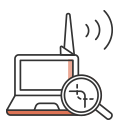
Finds cross-modulation products caused by undesired signals at the antenna port.

Evaluates equipment's tolerance to current flowing through its chassis or structure.
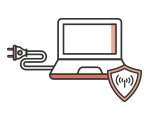
Injects RF current directly onto cable bundles to verify equipment continues operating normally in the presence of induced cable interference.

Injects impulse signals onto cable bundles to verify equipment tolerance to transient cable interference.
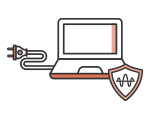
Tests a device's ability to endure damped sinusoidal transients coupled onto its power leads and associated cables.

Tests equipment's ability to withstand transient signals representative of lightning-induced surges on cables and power leads.

Tests equipment's tolerance to electrostatic discharge from personnel handling the device.
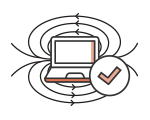
Measures magnetic-field emissions radiated by the equipment at low frequencies.

Ensures a device and its cabling stay below the specified threshold for electric field emissions.
Measures spurious and harmonic emissions radiated from a transmitting antenna.

Tests equipment's tolerance to externally applied low-frequency magnetic fields.

Tests equipment's tolerance to externally applied electric fields across a broad frequency range.

Tests equipment's tolerance to a transient electromagnetic pulse representative of EMP exposure.
Where Are MIL-STD-Tested Laptops & Tablets Used?
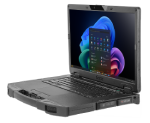
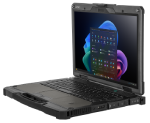
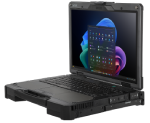
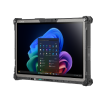
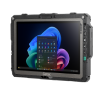
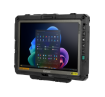
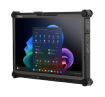
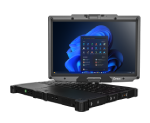
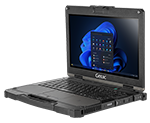
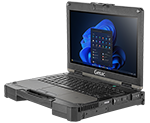
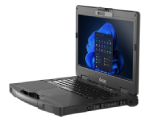
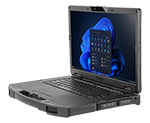
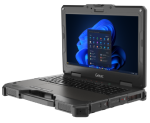
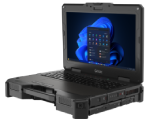
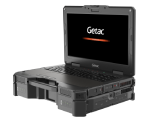
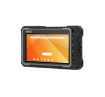
Work in demanding environments is made easier with Getac's rugged laptops and tablets. Tested to selected MIL-STD methods, our fully rugged devices work where you do. Typical applications include:
DEFENCE
Flightline maintenance, command and control, mission planning and logistics, where devices face temperature extremes, dust, vibration and electromagnetic constraints. For example, Getac worked with the US Air Force to customise the F110 rugged tablet for munitions handling, where strict electromagnetic radiation rules limit wireless technology near electrically initiated devices and explosives.
LAW ENFORCEMENT & PUBLIC SAFETY
In-vehicle and on-foot use, with ongoing vehicle vibration, heat build-up in parked cars, and exposure to rain.
UTILITIES
Outdoor inspection, maintenance and outage response in rain, dust and wide temperature swings.
EVERYDAY INCIDENTS
Sometimes coffee gets spilled and devices get dropped.
TRANSPORT & LOGISTICS
Warehouse picking, yard management, in-vehicle dispatch and last-mile delivery, where devices face constant vehicle vibration, drops during loading and unloading, moves between cold storage and warm loading docks, and rain and dust on the road.
MANUFACTURING
Production line inspection, equipment maintenance, quality control and inventory tracking on the factory floor, where devices face machine vibration, dust and debris, heat near production equipment, and drops onto concrete floors.